Forgotten Tales
Russian Miniatures for Piano
Click Play to begin listening, then scroll down to read program notes!
About the Music
In Western classical music, besides larger complex forms such as Symphonies or Sonatas, there exist smaller forms known as miniatures or character pieces. These are shorter, self contained pieces intended to capture a mood, emotion or extramusical idea. Prioritizing intimate expression over sprawling structural complexity, pieces such as Nocturnes, Impromptus, Preludes became popular in 19th century concert programs.
While their origins can be traced back to the Baroque era (consider for example pièces de caractère by Couperin and Marais) there was also a certain presence in the Classical era as well (e.g. Beethoven’s Bagatelles) setting the stage for burgeoning of this concept in the Romantic era. Examples abound, including Chopin’s Nocturnes, Preludes and Mazurkas, Mendelssohn’s Songs without Words, and Schumann’s albums of mood pieces like Carnaval and Kinderszenen. Liszt pushed the idea further, adding his own emotional nuances as well as extreme virtuosity in compositions such as Consolations, Liebestraum, Harmonies poétiques et religieuses and Nuages Gris.
In Russia, miniatures evolved from salon type pieces to highly descriptive poetic and sometimes virtuosic canvases often imbued with Russian folk idioms and story telling. Mikhail Glinka, often considered the father of Russian classical music, began integrating native Slavic melodies and dance rhythms into his piano works, creating essentially the foundation to the Russian nationalist movement. This nationalist identity was cemented by the “Mighty Handful” (or “The Five”) - Mily Balakirev, Modest Moussorgsky, Nikolai Rimsky-Korsakov, Alexander Borodin and César Cui - eschewing European forms, favoring instead uniquely Russian sounds. The quintessential example would be Moussorgsky’s Pictures at an Exhibition, a cycle of ten character pieces, essentially musical impressions of ten paintings by Moussorgsky’s friend Victor Hartmann, all united by the Promenade theme and its related interludes joining each piece, or painting.
In this set of recordings which I entitled “Forgotten Tales,” I have chosen to focus on lesser known Russian miniatures, some of which were written by well known composers, whereas others were written by more obscure composers, including some virtually forgotten by history. All display some core aspect of what I would call the Russian Soul, sometimes deeply melancholic in a way that only Russians seem to be able to convey, and other times radiant, joyous and brilliant. All are gems and deserve to be heard more. I use the term “Tales” as a direct reference to Medtner’s Skazki (“Fairy Tales”) which conclude this set. Although many of the other pieces in this set do not have as strong programmatic reference, I find that all have a story to tell in their own way.
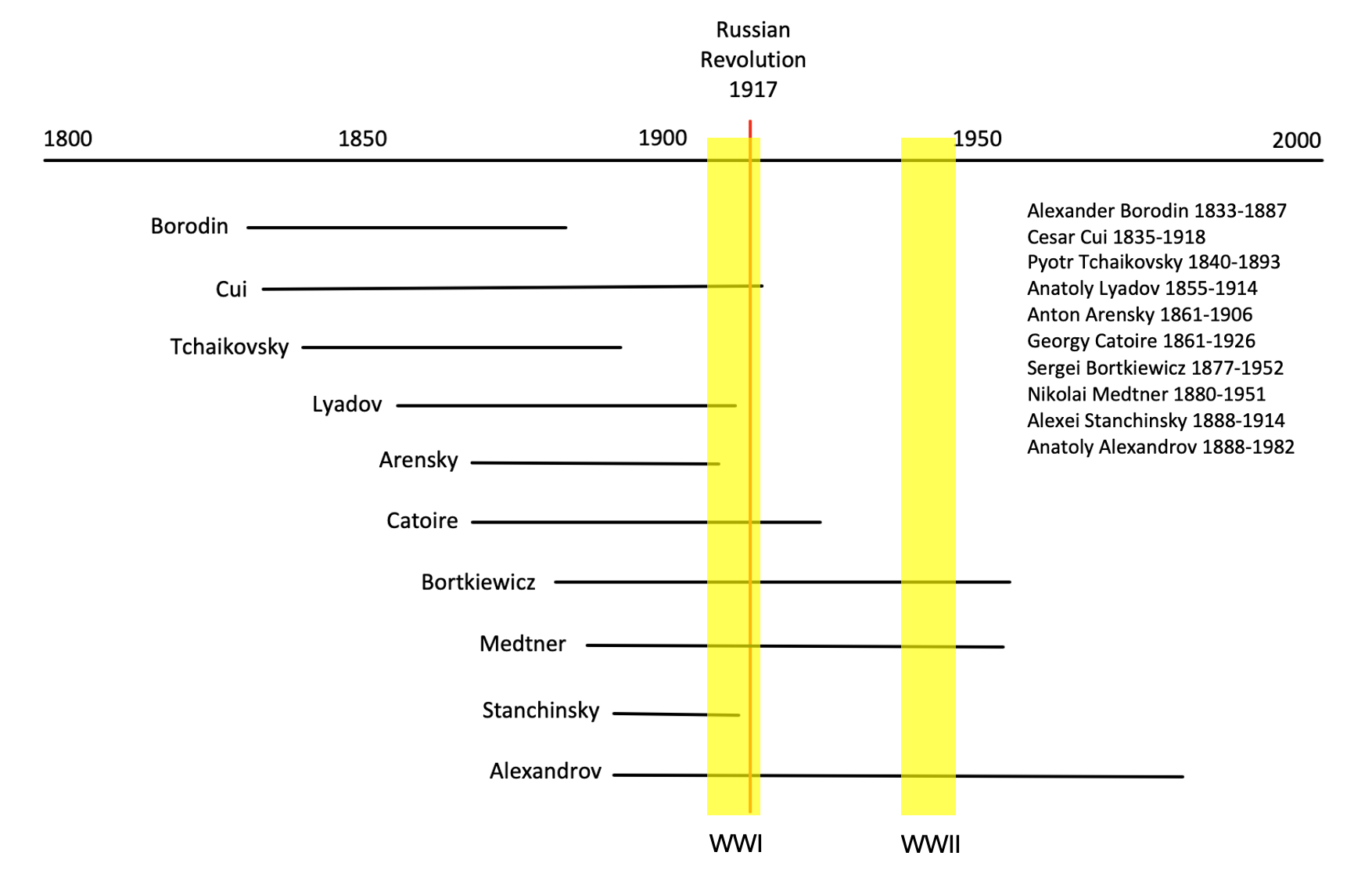
This set begins with a Prelude by César Cui (1835-1918), from his cycle of 25 Preludes, Op. 64. Cui, the least traditional for “Mighty Handful,” was a disciple of Balakirev who recognized Cui’s precocious musicality. As part of The Five, Cui was a likeminded kindred spirit in the late 19th century Russian nationalist movement. Interestingly, however, in his 25 Preludes, Op. 64, Cui clearly pays homage to European composers, particularly Chopin and Schumann. His 25 Preludes traverses all of the major and minor keys and even includes an additional Prelude to make 25 total. Cui cycles through the circle of fifths, although in a different way than Chopin. Instead of pairing each major key with its relative minor before moving along the circle, Cui pairs each major key with its mediant minor. Subsets of the Preludes are dedicated to renowned pianists and students of Liszt and Leschetizsky. Prelude No. 19 is in the subset (17-19) dedicated to celebrated pianist and friend, Josef Slivinsky. Nos. 20-22 were dedicated to pianist Ignaz Paderewsky. Prelude No. 19 has a light lyrical feel, akin to an étude-caprice.
Sergei Bortkiewicz (1877-1952), born in the Ukranian city of Kharkov, had his early musical training at the Kharkov Music School, which was co-founded by his pianist mother. Because the school was affiliated with the Imperial Russian Music Society, he was fortunate to experience early influences from Tchaikovsky and Rubinstein who visited and concertized there. He later studied at the St. Petersburg Conservatory, but to please his father, he agreed with some reluctance to study Law. Before he could finish, however, the school closed due to student unrest and Bortkiewicz decided to abandon law in favor of returning back to his true love, music. The school closure was one of many larger successive setbacks throughout his life - including WWI, the Russian Revolution, and WWII - resulting in multiple reversals of fortune. With successive moves necessitated by external crises, large portions of his compositions unfortunately became lost. At various points in his career he relocated to European cities including Vienna, Budapest, Paris, and in Italy. His final years were spent in Vienna, and he became an Austrian citizen in 1926, the same year he published his Preludes, Op. 33. Although Chopin’s influence is clear, there is an unmistakable Russian flavor in each. Influence by Chopin as well as Liszt is also evident in his Lamentations and Consolations, Op. 17, which were composed in 4 pairs. I present the third pair (Nos. 5 & 6). In his Lamentation No. 5 in A minor, subtitled “Le mal du pays,” his homesickness is palpable. The following Consolation in A major is like salve easing some of the pain.
Anton Arensky (1861-1906) was a musical prodigy and studied under Rimsky-Korsakov at the St. Petersburg Conservatory. After graduating with a gold medal, he became a professor at the Moscow Conservatory where Tchaikovsky championed his works. Over time, his music showed increasing influence of Tchaikovsky, as opposed to the more nationalist Five. He is best known for his lyrical chamber works such as his Piano Trio in D minor, Variations on a Theme by Tchaikovsky, String Quartet No. 2, and many piano works. 24 Characteristic Pieces, Op. 36, a set of miniatures for piano, was probably inspired my Bach’s Well-Tempered Clavier. As such is also traverses all 24 major and minor keys. No. 3 is a Nocturne displaying Arensky’s gift for lush lyricism and No. 16 is an Élégie, which so effectively captures how grief often comes in waves.
Despite an early aptitude for music, Pyotyr Ilyich Tchaikovsky (1840-1893) was guided to a career in civil service by his parents. After attending the elite Imperial School of Jurisprudence in St. Petersburg he worked as a bureau clerk. Because Tchaikovsky seemed to continue to be obsessed with music, his father hired German pianist Rudolph Kündinger to assess whether the young Pyotyr had enough musical talent to pursue it as a career. Kündinger pronounced that Pyotyr had “no musical talent and he is not suitable for a musical career - and it is too late to start.” Fortunately, Tchaikovsky decided to pursue music anyway while continuing to work as a civil servant. While at St. Petersburg Conservatory, Anton Rubinstein, 10 years his senior and not yet famous, saw Tchaikovsky’s obvious talents and urged him to study music full time. After finishing his training he stayed on teaching at the Conservatory for the next 10 years. Here he came into contact with The 5 - Balakirev in particular was influential, encouraging him to write Romeo and Juliet. Tchaikovsky’s life was difficult because of his homosexuality which he kept secret because it was illegal in 19th century Imperial Russia. He did marry Antonina Miliukova as a ruse to enter acceptable bourgeois life, but he left the marriage within weeks. A mental breakdown followed. Fortunately for Tchaikovsky, Nadeshda von Meck, a wealthy businesswoman and patroness became his lifeline allowing his creativity to flow, free from material worries for the next 13 years.
In 1875 Tchaikovsky composed The Seasons, Op. 37a for the St. Petersburg magazine Nouvellist. A set of 12 character pieces intending to capture the varying moods of Russian life and nature in each successive month throughout a year, the original publication also included poetic epigraphs from celebrated writers such as Pushkin supporting the music with a narrative program. June (Barcarole) is the most well known piece in this cycle. The accompanying epigraph is by Russian poet Apollon Maykov:
Let us go to the shore; there the waves will kiss our feet.
With mysterious sadness, the stars will shine upon us.
Alexander Borodin (1833-1887) led a fascinating double life as an accomplished organic chemist as well as a composer. He met Balakirev in 1862 and joined him as part of The 5 to promote nationalistic music with a uniquely Russian sound. His best known works include Symphony #2, In the Steppes of Central Asia, and Polovtsian Dances from his opera Prince Igor. Borodin composed his Scherzo in A-flat in 1884 when he was in Belgium for an early performance of his opera Prince Igor which was still incomplete at the time. Glazunov later transcribed the Scherzo for orchestra, and his friend and dedicateé Théodore Jadoul transcribed it for piano 4-hands. The Scherzo is driven by a lively motoric theme and rapid scalar passages. It conveys a mood of lighthearted mischief and is full of virtuosic flair.
Born into a prominent musical family Anatoly Lyadov (1855-1914) studied at St. Petersburg Conservatory. Although he was expelled from Rimsky-Kosakov’s class for absenteeism, he eventually graduated in 1878 and ultimately became a professor of elementary theory there. Young Prokofiev, who was his student, found Lyadov to be likeable but somewhat dry and pedantic. Lyadov’s critics found that while his fastidious and perfectionist nature allowed him to excel in miniatures, the larger forms did not come as easily. He initiated but never completed an opera called Zoryushka. His slow writing habits in fact made him miss a deadline for a commission by Impresario Sergei Diaghilev for music intended for a new ballet. As Lyadov was too slow to commit, the much younger and less experienced Igor Stravinsky was brought on to the project which eventually became The Firebird. As a perfectionist notoriously plagued by self doubt, Lyadov was most comfortable with short forms, composing numerous Preludes for piano in seven distinct sets. While there is a clear homage to Chopin, the Preludes have a unique Russian nationalistic flavor. Among these, the Prelude in D flat, Op. 57, No.1 is probably the most well known.
Georgy Catoire (1861-1926) was born in Moscow to a French émigré family. Although he showed musical promise at an early age, he was guided into mathematics by his family, graduating with honors from Moscow University in 1884. Fascinated by music, he traveled to Berlin to study piano and harmony and developed an important appreciation for Wagner, which was at odds with the evolving Russian Nationalist school. However, Catoire’s potential was recognized by Tchaikovsky, who recommended more formal training by Rimsky-Korsakov and Lyadov. During this period, he became close friends with Arensky as well. Sadly, Catoire’s family friends and colleagues were not supportive of his choice of a career as a composer, and in 1899 after a series of disappointments, he essentially withdrew from society, moved to the countryside, and nearly gave up composing altogether. Following the acclaim for his Symphony in C minor, Op. 7 which was a rescoring and expansion of his Sextet to a full orchestral piece, he successfully emerged from his seclusion. From 1919 onwards, he was a Professor of Composition at Moscow Conservatory and wrote several treatises on theory and composition during his tenure. His most famous composition pupil was Dmitri Kabalevsky. Catoire is largely forgotten today, possibly as a result, per historian Leonid Sabaneyev, of “having suffered from the ‘single, but nowadays unpardonable fault of modesty, an inability to advertise himself.’” Beyond this, his conservative approach to composition had little in common with the aesthetic demands of later Soviet government. Catoire’s musical style is probably best understood as a fusion of Russian lyricism, German counterpoint and French impressionism. His short character pieces for piano focus on psychological introspection, poetic atmosphere and emotional color.
Anatoly Alexandrov (1888-1982) grew up in a musical family and received his first piano lessons from his mother. He went on to study at the Moscow Conservatory where he studied with reknowned theorists like Taneyev among others. Many say that his music is a synthesis of Rachmaninoff, Scriabin and Medtner with Russian folklore. His 14 Piano Sonatas and numerous character pieces for piano emphasize poetic story telling and deep introspection. His Preludes, Op.1 are his earliest known surviving works and can be seen to be rooted in post-Scriabin Russian modernist movement, blending deep chromaticism, harmonic ambiguity and strong melodic lyricism.
Alexei Stanchinsky (1888-1914) was a musical prodigy, performing and composing by the age of 5. He studied with Taneyev among others at Moscow Conservatory. Unfortunately following the death of his father in 1910, Stanchinsky had a mental breakdown - possibly schizophrenia in modern terms - and spent a great deal of time hospitalized as well as secluded in a monastery. During his delusional states, he destroyed much of his compositions. After a two year recovery, he began to collect folk tunes and returned to Moscow Conservatory. In March 1914 he participated in a high profile concert of Moscow composers in what seemed to signal a major comeback. Tragically however he died just months later in an apparent drowning, although some suspected suicide. Modern pianists recognize Stanchinsky as one of the most innovative and haunting voices of pre-Revolutionary Russia.
Nikolai Medtner (1880-1951) began his musical studies at age 10 at the Moscow Conservatory. He initially pursued performance, winning the Anton Rubinstein Prize at age 20, and was considered second only to Rachmaninoff as a pianist. However, as perplexing as it was to his family, Medtner turned to composition with the support of his teacher, Taneyev.
Unlike Rachmaninoff, Medtner did not leave Russia until well after the Revolution. In 1921 he moved to Berlin, then to France in 1924 due to the cost of living. Medtner found that his music attracted little interest in either country because, as he viewed it, people were more interest in “modernism.” He found it difficult to survive financially, in part because he was not interested in performing works by other composers. He did embark on several successful tours between 1924-1935 to America, France, Britain, and also in his native Russia. He found the British most receptive and moved to London in 1935, making a living teaching, performing and composing. WWII caused him a great deal of hardship, as did increasingly poor health. Fortunately, the Maharajah of Mysore, an amateur pianist and patron, created the Medtner Society with the objective of recording all of Medtner’s music. Despite poor health, Medtner was able to record all three of his Piano Concertos with the Philharmonia Orchestra, several sonatas and chamber music as well as many songs (with Elisabeth Schwarzkopf) and shorter piano works before he died in 1951.
Although Medtner was born in Russia, his family had roots in Germany from the 18th century. Perhaps then it may not be surprising that his musical inclinations were a fusion of Germanic principle and attention to structure, with a Russian spirit. Medtner considered himself to be a follower of Beethoven, German Romanticism in general and Schumann in particular. Rachmaninoff believed Medtner to be the greatest composer of their generation. Everything Medtner composed always included his own instrument, piano. His considerable output includes 14 Piano Sonatas, 3 Piano Concertos, and 38 Skazki (“Fairy Tales”). The latter contain some of his most original and appealing music.
Medtner’s Skazki are essentially miniature tone poems for the piano. In this loose form, he explored Russian folklore although he did not adhere to a strict story line or program. Skazki are best understood to be psychological journeys, or “tales of personal experiences.” Medtner gave programmatic titles or literary epigraphs to only twelve of his 38 Skazki.
Medtner’s Four Skazki Op. 26 are examples of those without associated programmatic titles. Within that set Skazki No. 2 has a bright sunny disposition in contrast to many of his more brooding works. There is a chasing dynamic, with the right hand performing a running or scurrying action while the left hand chases, sometimes with wide leaps, offbeat accents and interjections. Also from Op. 26, his Skazki No. 3 has a more narrative and melancholic character. Its presenting melody is at once melismatic and serpentine and effectively conveys a yearning and questioning quality. The ABA form of this movement fits in what might be considered a very condensed sonata-allegro format.
While Medtner also did not attach any programmatic titles to his three Skazki Op. 42, the second is subtitled In the Phrygian Mode. Composed in France in the 1920’s, its form is not strictly binary or tertiary but rather displays continuously evolving motifs. As the subtitle suggests, Medtner explores the Phrygian mode which creates an ancient evocative modal color. The harmonies suggest some French influence, possibly Fauré or early Debussy.
Medtner’s Idyll, the first of three Arabesques, Op. 7, evokes the innocence and simplicity of Russian folklore and nature. Following a ternary (A-B-A) form with a coda, Medtner takes the germinal motif and sequentially develops and varies it throughout the sections. With Idyll, Medtner captures the essence of a tranquil reverie, blending human daydreams with enchanted, supernatural folk elements.
Medtner’s Six Skazki Op. 51 are dedicated to two central characters from Russian folklore: Cinderella (Zolushka) and Ivan the Fool (Ivanushka). In the Russian version of Cinderella, instead of a Fairy Godmother, Zolushka is aided by indigenous magic such as the protective spirit of her deceased mother or a magical talking animal. Skazki Op. 51, No. 3 is a portrait of Cinderella, emphasizing her charm, beauty, and dreamlike qualities. The Zolushka theme is genial and pure of heart. You can hear her both in her daily chores which she approaches with grace, as well as friction-filled encounters with her adoptive family. The ending cadenza reveals her magical transformation.
Skazki Op. 51, No. 6 is dedicated to Ivan the Fool. The youngest of three brothers, Ivan is often perceived as simple minded or lazy, but his kindness, guileless nature and willingness to help others allow him to triumph where others, including his more clever brothers, fail. Foolishness in this tale is more an expression of Ivan’s humility, purity of heart and freedom from greed. As a “wise fool” he is connected deeply with nature and magic, enabling him to achieve great deeds, marry a princess and gain kingdoms. In the opening, the off-kilter repeated notes is Ivan’s motif, possibly signifying stuttering and bumbling, making him seem foolish. As the movement progresses, you can hear him getting into, and magically getting out of, one scrape after another. At the end a magical transformation allows him to heroically succeed against all odds.
It is fair to say that, while respected by musicians and intellectuals, Medtner lived his final 30 years in the West in abject poverty. In a letter to soprano Tatiana Makushina, he stated “I have a horrible feeling that this whole story will turn out to be another fairy tale about ‘Ivan the Fool’ who I have already proved myself to be so many times in my life” - although, he perceived, without any magical endings.